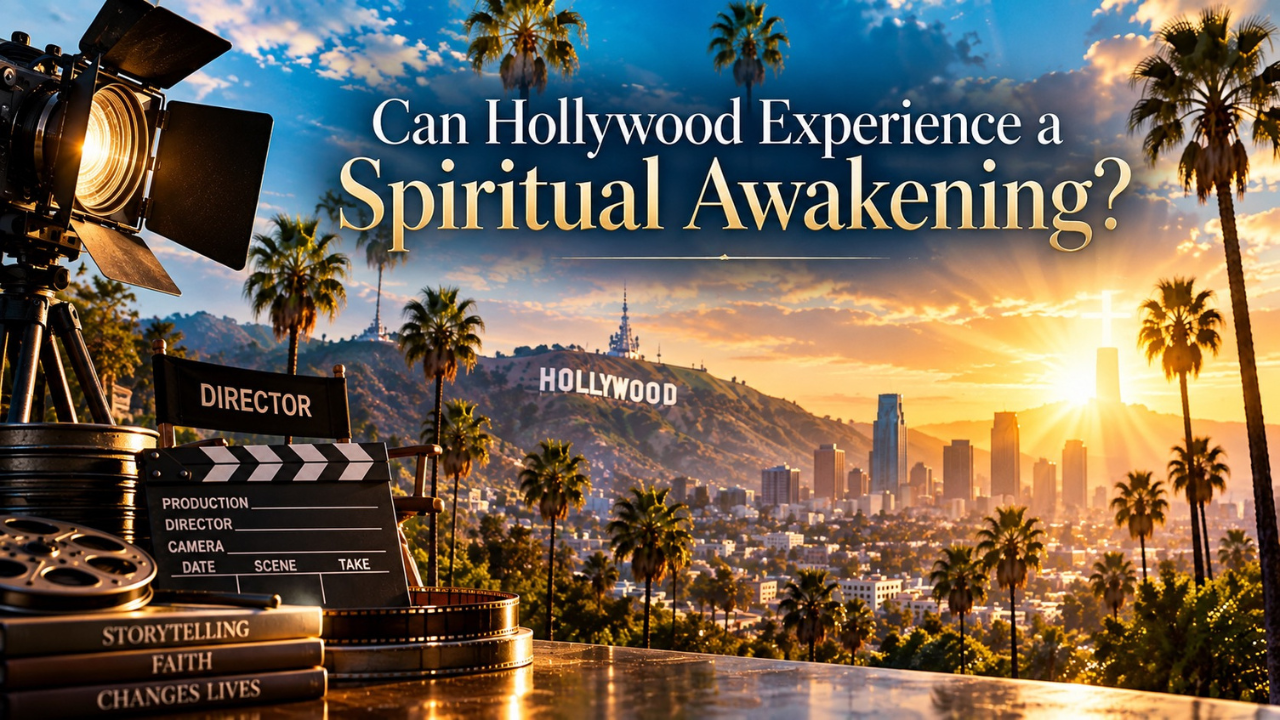
For generations, Hollywood has helped shape the stories America tells about itself. At a time of cultural division, technological disruption and spiritual searching, a different question is emerging: Could the entertainment industry itself become part of a new movement of faith and renewal?
By Troy Anderson
For more than a century, Hollywood has been one of the world's most influential centers of storytelling, producing films and television programs that have entertained billions of people while helping shape attitudes about family, faith, morality, success, identity and the meaning of life.
As an investigative journalist, I have spent much of my career examining the forces that shape culture. Over the years, I have interviewed pastors, authors, filmmakers, actors, political leaders, military figures and people whose lives have intersected with some of the most important cultural and spiritual movements of our time.
One lesson has become increasingly clear to me: stories matter.
They can reinforce the assumptions of a culture, or challenge them. They can deepen cynicism, or restore hope. They can encourage people to see themselves as isolated individuals, or remind them that their lives may be part of a much larger story.
That is one reason I have become increasingly interested in a question that might have seemed improbable to many people only a few years ago.
Could Hollywood experience a spiritual awakening?
The Power of Story
Long before streaming platforms, social media or artificial intelligence, human beings used stories to understand the world.
The Bible itself communicates many of its greatest truths through narrative. Jesus frequently taught through parables. Throughout history, writers, poets, playwrights and artists have explored questions of sacrifice, redemption, justice, temptation, courage and faith through stories.
Modern entertainment operates on an unprecedented scale.
A successful film can reach audiences across continents. A television series can influence conversations for years. A single scene can become part of the cultural vocabulary of an entire generation.
That influence carries enormous responsibility.
When people think about Hollywood and faith, the discussion sometimes becomes unnecessarily adversarial. Entertainment is portrayed as inherently hostile to Christianity, while Christians are sometimes depicted as disconnected from the creative world.
Reality is more complicated.
Hollywood is not a single worldview or institution. It is an enormous community of writers, actors, directors, producers, executives, craftspeople, technicians and entrepreneurs with widely different beliefs and backgrounds.
Many people working within the entertainment industry are people of faith. Others are searching spiritually. Still others may have little interest in religion but remain deeply concerned with questions of meaning, human dignity, family, justice and hope.
That complexity creates opportunities for conversations that are often missed when culture is viewed only through the lens of conflict.
Faith Has Always Had a Place in Hollywood
The relationship between Christianity and American entertainment is not new.
Biblical epics were once among Hollywood's most ambitious productions. Films such as The Ten Commandments and Ben-Hur demonstrated that stories rooted in Scripture could become major cultural events.
Faith themes have continued to appear throughout American cinema in many forms, sometimes explicitly and sometimes through stories centered on redemption, sacrifice, forgiveness and transformation.
In recent years, audiences have also demonstrated continuing interest in entertainment dealing seriously with faith and biblical history. The success of faith-oriented films, television productions and independent projects suggests that spiritual themes remain relevant to a substantial audience.
But I believe the more interesting development may be occurring beyond any particular film or television series.
Across America, conversations about faith, purpose and spiritual awakening appear to be finding new audiences, including among people who may not fit traditional assumptions about who is interested in Christianity.
That deserves attention.
A Culture Searching for Meaning
We are living through a remarkable period of disruption.
Artificial intelligence is transforming creative industries. Social media has changed how people communicate and understand themselves. Political and cultural divisions have strained relationships and institutions. Young people are confronting questions about identity, purpose and the future in an environment shaped by technologies that did not exist when their parents were growing up.
At the same time, loneliness, anxiety about the future and distrust of institutions have become recurring themes in American life.
Technology can provide extraordinary tools, but it cannot answer humanity's oldest questions.
Why are we here? What gives life meaning? What is worth sacrificing for? Can people truly change? Is forgiveness possible? Is there hope beyond suffering?
Those are spiritual questions, whether or not they are always described that way. They are also the questions behind many of the world's greatest stories. That is why I believe this cultural moment presents an unusual opportunity for storytellers who are willing to engage seriously with faith, truth and the human condition.
Revival Is About People
When Christians hear the word “revival,” they may picture a church service, a tent meeting or one of the great spiritual awakenings of American history.
Those movements are important, but revival is ultimately about people.
It begins when individuals encounter God, reconsider the direction of their lives, reconcile broken relationships, rediscover faith or become willing to follow a calling they previously ignored.
If a spiritual awakening were to touch Hollywood, I do not believe it would necessarily begin with an institution announcing that it had changed.
It would begin with people. A writer deciding to tell a different kind of story. An actor becoming more open about faith. A producer taking a chance on a project centered on redemption. A filmmaker recognizing that audiences are hungry for meaning as well as entertainment.
People praying together. Relationships forming across denominational, professional and cultural boundaries. Creative communities asking whether the stories they tell can contribute to something larger than commercial success.
That kind of change is difficult to measure in its earliest stages. Cultural movements often appear small before they become visible.
The Opportunity for Christians
Christians also have responsibilities in this conversation.
It is easy to criticize culture from a distance. It is much harder to enter the creative world, build relationships, develop professional excellence and tell stories compelling enough that people actually want to experience them.
If Christians hope to contribute meaningfully to entertainment, quality matters. A film does not become excellent simply because its message is sincere. A television series does not become compelling merely because its values are admirable. Storytelling requires craftsmanship, imagination, discipline, character development, emotional authenticity and respect for the audience.
The same principle applies to journalism, publishing and every other form of media.
Truth deserves excellent storytelling. That means Christians who feel called to entertainment should not view Hollywood merely as a territory to be conquered. They should see it as a community of people to understand, serve, collaborate with and, when appropriate, challenge through the power of exceptional stories.
The Hollywood Revival
These ideas are among the reasons we have been developing The Hollywood Revival, an initiative centered on faith, storytelling, cultural renewal and the possibility of spiritual awakening within the entertainment community.
The vision is not simply to organize another event.
It is to help create conversations and relationships among people in entertainment, media, ministry and the creative arts who believe that stories can contribute to healing, hope and spiritual renewal.
Related to this vision is The Untold Story of Faith in Hollywood, a documentary TV series exploring a part of entertainment history that is often overlooked: the role faith has played in the lives of artists, filmmakers and cultural figures, and the continuing influence of spiritual conviction within the entertainment world.
There are extraordinary stories to tell. Some are historical. Others are unfolding now. Together, they raise a larger question about what Hollywood's next chapter might look like.
A Different Kind of Cultural Influence
For years, discussions about faith and culture have often been framed as a battle over who controls institutions. Perhaps there is another way to think about influence.
Culture changes when people encounter ideas powerful enough to change how they see the world.
The most enduring stories rarely tell audiences what to think. They invite people into experiences that cause them to think more deeply about themselves, other people and the meaning of life.
That is where artists and storytellers possess extraordinary influence. A story about forgiveness can reach someone who would never attend a sermon about forgiveness. A story about sacrifice can demonstrate courage more powerfully than an argument about courage. A story about redemption can remind someone who has lost hope that a life can change.
For people of faith working in entertainment, that may be one of the greatest opportunities of this generation.
What Would Awakening Look Like?
No one can manufacture a genuine spiritual awakening. History suggests that such movements rarely unfold according to human plans. They often emerge during periods of instability, cultural transition and spiritual hunger.
But people can prepare. They can pray. They can build relationships. They can create excellent work. They can encourage people who feel isolated in their faith. They can tell stories that recognize both the brokenness and dignity of human beings. They can make room for conversations about God that are thoughtful rather than performative.
And they can remain alert to what may already be happening quietly around them. Perhaps the question is not simply whether Hollywood can experience revival. Perhaps the more important question is whether people who believe in the transforming power of faith are prepared to serve, create and tell stories if that opportunity comes.
Hollywood has spent more than a century telling stories that have traveled around the world. The next great story may be about what happens within Hollywood itself.
About The Hollywood Revival
The Hollywood Revival is an initiative bringing together voices from entertainment, media and ministry around faith, storytelling, spiritual awakening and cultural renewal. Troy Anderson is also developing The Untold Story of Faith in Hollywood, a documentary TV series exploring the often-overlooked role of faith in Hollywood history and its continuing influence in the entertainment world.