As America approaches the 2026 midterm elections, Vice President JD Vance’s extraordinary discussion of the End Times, the Antichrist and the spiritual dangers surrounding artificial intelligence is bringing questions once largely confined to churches and prophecy conferences into the national conversation.
By Troy Anderson and Pastor Paul Begley
For generations, discussions about the Antichrist, the End Times and the prophetic warnings of Revelation largely belonged to pulpits, Bible studies, prophecy conferences and Christian broadcasting.
Now those words are being spoken by the vice president of the United States.
In a remarkable interview with Christian podcaster Bryce Crawford, Vice President JD Vance openly discussed whether humanity could be approaching the biblical End Times—and whether the figure Christians know as the Antichrist could already be alive.
“Do I think that we’re in the end times? I don’t know,” Vance said, while cautioning Christians against becoming consumed by speculation.
But then came the statement that reverberated across the media.
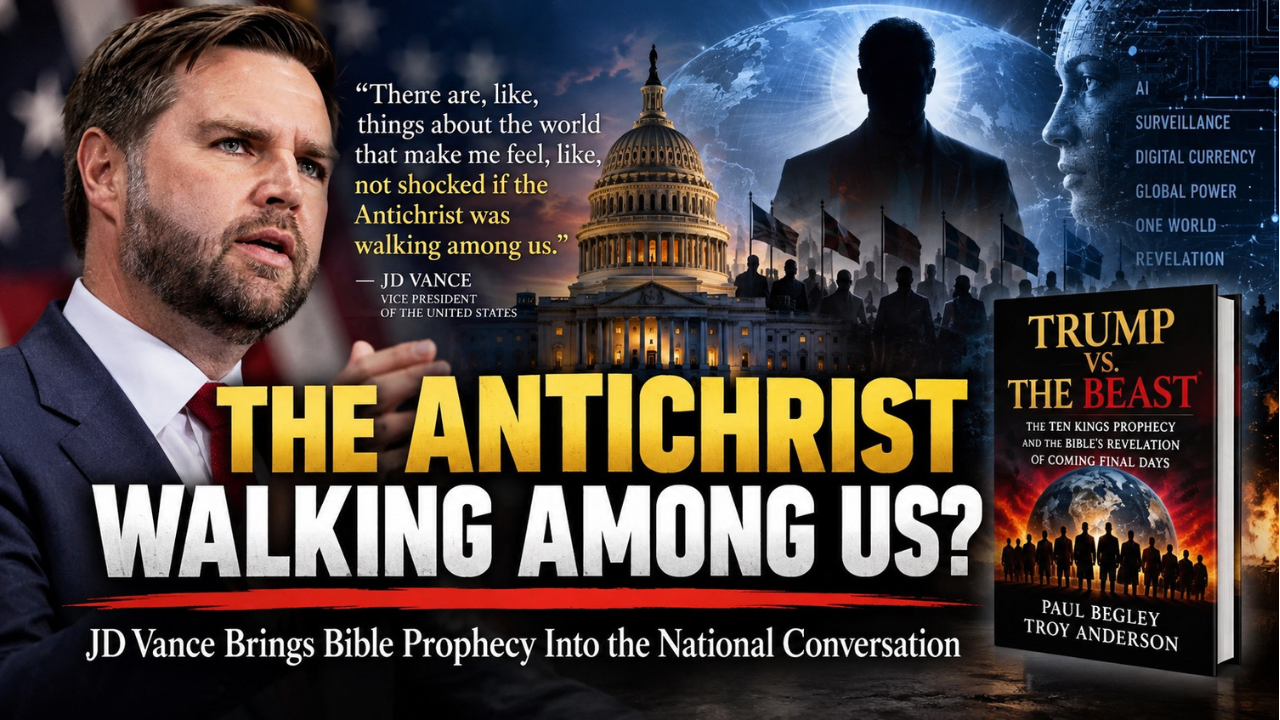
“There are, like, things about the world that make me feel, like, not shocked if the Antichrist was walking among us,” Vance said.
Vance did not claim that the Antichrist is definitely alive today, nor did he identify any contemporary figure as the Antichrist. Instead, his comments were speculative and accompanied by repeated cautions against becoming obsessed with end-times predictions.
Still, the significance of the conversation is difficult to miss.
At a moment when artificial intelligence, digital surveillance, geopolitical conflict, rapidly evolving technology and questions about the future of humanity dominate headlines, one of America's highest-ranking elected officials is publicly discussing the same biblical themes Christians have debated for nearly 2,000 years.
From the Prophecy Pulpit to the National Conversation
Vance told Crawford that his fascination with Bible prophecy stretches back to his youth. But his comments were not limited to abstract theology.
He connected his spiritual concerns to developments unfolding in the modern technological world—particularly artificial intelligence.
Vance described feeling what he called “really, really weird spiritual dark energy” around some aspects of the AI industry and expressed concern about replacing fundamentally human relationships with artificial intelligence.
The comments come as society wrestles with questions that only a generation ago belonged largely to science fiction: How much authority should humans surrender to algorithms? What happens when machines imitate human reasoning and relationships? Could biometric identification, digital currencies and interconnected technological systems eventually make unprecedented forms of economic and social control possible?
Those questions also intersect with one of the Bible’s most debated passages.
Revelation 13 describes a future system in which people cannot “buy or sell” without the mark associated with the Beast. For centuries, Christians could only speculate about how such a system could operate on a worldwide scale.
Today's technologies do not, by themselves, establish that Revelation 13 is being fulfilled. Nor does Scripture authorize believers to simply label every new technology the “mark of the beast.”
But the technological capacity for extraordinarily sophisticated identification, surveillance and control is no longer theoretical.
That is one reason the conversation surrounding Bible prophecy has changed so dramatically.
The Question at the Heart of Trump vs. the Beast
These are precisely the questions Pastor Paul Begley and I (investigative journalist) Troy Anderson examine in our new book, Trump vs. the Beast: The Ten Kings Prophecy and the Bible's Revelation of Coming Final Days (Humanix Books/Newsmax Media, October 6, 2026), the #1 "Hot New Release" in "Prophecies" on Amazon.
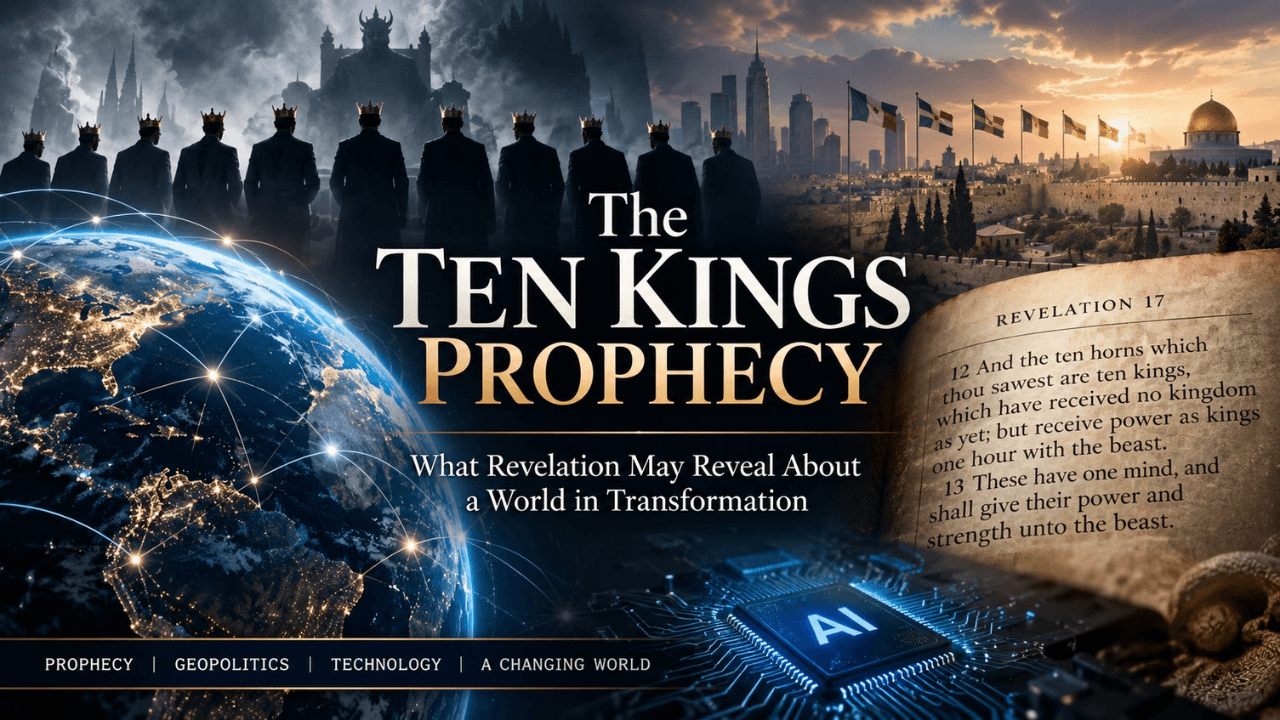
The book examines the convergence of biblical prophecy, geopolitics, artificial intelligence, technological power, global institutions and the mysterious “ten kings” described in Revelation 17.
Rather than simply attempting to name an individual who could become the Antichrist, Trump vs. the Beast investigates a broader question:
Could the political, financial and technological architecture necessary for the biblical Beast system already be taking shape?
Revelation 17 describes ten kings who “receive authority for one hour with the beast” and who ultimately “give their power and authority unto the beast.”
For centuries, interpreters have disagreed over exactly who—or what—these ten kings represent.
Trump vs. the Beast explores those competing interpretations against the backdrop of an increasingly interconnected world in which governments, multinational corporations, technology companies, financial institutions and international organizations can wield influence across national borders.
The book's central argument is not that Christians can definitively identify the Antichrist today. Rather, we examine whether the systems emerging around us could eventually provide the infrastructure through which the kind of centralized power described in Revelation could operate.
That distinction matters.
Jesus warned His followers to “watch” while simultaneously warning them against deception.
A Vice President Talks About Spiritual Darkness
Another striking portion of Vance's interview concerned his encounters with world leaders.
Vance said there have been meetings in which someone made a comment that triggered what he described as spiritual alarm bells.
“I've been in meetings with world leaders where various issues are being discussed, and somebody will say something or somebody will make an observation and I'll feel some darkness about it,” Vance said.
That is an extraordinary description from a sitting American vice president.
Political leaders routinely discuss economics, military strategy, diplomacy and national security. They rarely publicly describe international encounters in explicitly spiritual terms.
Whether Americans share Vance's interpretation or not, the interview illustrates something significant happening within American public life: religious language about spiritual warfare, prophecy and the End Times is increasingly intersecting with conversations about politics and technology.
Prophecy and the 2026 Midterms
The timing is notable.
America's next regularly scheduled federal general election takes place November 3, 2026, when voters will determine control of Congress and decide thousands of state and local contests across the country.
Economic conditions, immigration, foreign policy, artificial intelligence, religious liberty, abortion, education and cultural issues are among the subjects shaping political debate.
For some Christian voters, however, another layer sits underneath those conventional policy questions.
They increasingly view world events through a biblical lens.
That does not mean Scripture provides a partisan voting guide. Christians themselves disagree sharply about candidates, parties and policies, and biblical prophecy has been interpreted differently throughout church history.
But Vance's interview demonstrates that questions once considered too unusual for mainstream political discussion have moved much closer to its center.
The Antichrist. The End Times. Spiritual warfare. Artificial intelligence.
The possibility that technological systems could fundamentally reshape human freedom.
These subjects are no longer restricted to late-night prophecy programs.
They are being discussed in the corridors of American power.
“Watch Therefore”
For Christians, the danger is moving toward either extreme.
One extreme dismisses prophecy altogether.
The other attempts to transform every headline, politician or technological development into definitive fulfillment of Scripture.
Jesus offered a different command:
“Watch therefore: for ye know not what hour your Lord doth come.” — Matthew 24:42
Watching does not mean panic.
It means discernment.
It means examining events carefully, testing claims against Scripture and refusing to allow either political allegiance or fear to replace biblical truth.
Vance himself acknowledged that danger. Although fascinated by eschatology, he said focusing on it excessively could be spiritually unhealthy because believers still have responsibilities in the present.
That caution may be as important as his headline-making statement about the Antichrist.
Christians have been waiting for Christ's return for nearly two millennia. Generations before ours also experienced wars, plagues, political upheaval and leaders whom believers suspected might fulfill prophetic roles.
No human being knows the prophetic timetable.
Yet every generation is commanded to remain awake.
Are We Watching the Architecture of Revelation Emerge?
That is ultimately the question explored in Trump vs. the Beast.
Not simply:
Who is the Antichrist?
But: What kind of world would have to exist for the Antichrist's system to function?
A world capable of monitoring commerce? A world interconnected through digital networks? A world in which identity can be authenticated electronically? A world where enormous political, financial and technological power can be concentrated in relatively few hands? A world searching desperately for leadership amid escalating crises?
Those questions no longer belong solely to speculative fiction.
Governments, corporations, theologians, technologists and ordinary citizens are already debating their implications.
That doesn't prove Revelation is being fulfilled before our eyes.
But it does make the ancient warnings of Scripture newly relevant to a technological civilization the Apostle John could only describe through the prophetic imagery recorded nearly 2,000 years ago.
Perhaps that is why Vance's comments attracted such attention.
The vice president didn't announce that the Antichrist had arrived.
He raised a question.
And millions of people are increasingly asking versions of the same one.
Trump vs. the Beast
In Trump vs. the Beast: The Ten Kings Prophecy and the Bible's Revelation of Coming Final Days, bestselling authors Pastor Paul Begley and Troy Anderson investigate the biblical prophecies surrounding the Antichrist, the mysterious Ten Kings of Revelation, artificial intelligence, technocratic power, global institutions, Israel and the accelerating geopolitical upheaval transforming the world.
The sequel to their bestselling Revelation 911, Trump vs. the Beast is published by Humanix Books and is scheduled for release October 6, 2026, in hardcover and digital formats.
The book asks readers not merely to watch the political headlines—but to examine the spiritual questions behind them.
Because whether the final events described in Revelation unfold in our generation or generations from now, Christ's instruction remains unchanged:
Watch. Pray. Discern. And be ready.